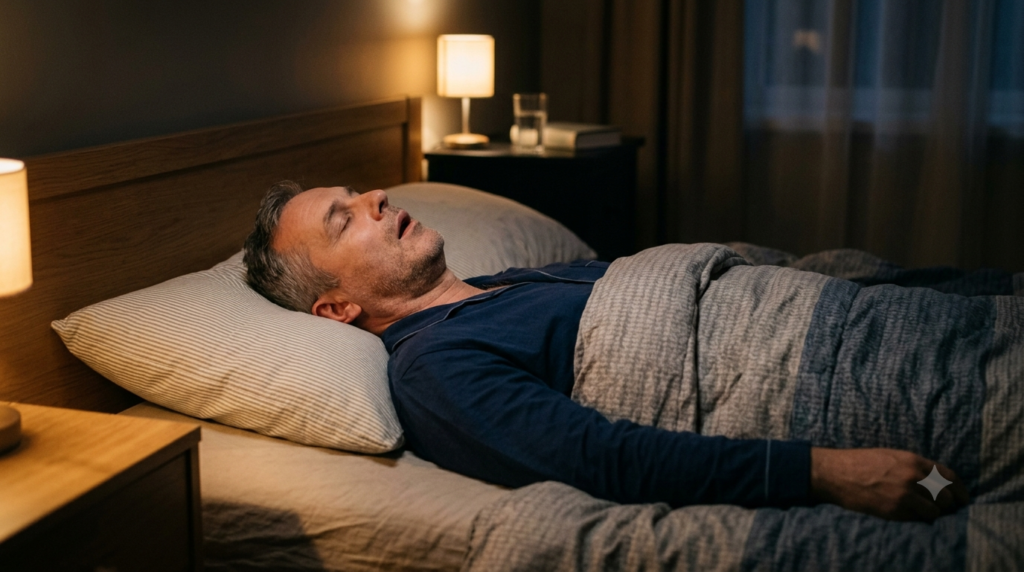
If your snoring seems noticeably louder when you sleep on your back, there is a fairly simple reason: your sleeping position can change the shape of your upper airway.
When you lie down, the muscles and soft tissues in your throat naturally relax. On your back, gravity can allow the tongue and other tissues at the back of the throat to move backward, narrowing the space through which air passes. As air moves through that narrower opening, the relaxed tissues can vibrate, producing the familiar sound of snoring.
That does not necessarily mean something is seriously wrong. Occasional snoring is common. But if your snoring is loud, happens most nights, or is accompanied by gasping, choking, breathing pauses, morning headaches, or daytime fatigue, the position of your body may be revealing something more important about how you breathe during sleep.
Why does snoring get worse when you sleep on your back?
The short answer is gravity.
Your upper airway is not a rigid tube. It is surrounded by muscles and soft tissues that help keep it open while you are awake. During sleep, those muscles become more relaxed.
When you sleep on your back, gravity can encourage the tongue and soft tissues toward the back of the throat. If the airway becomes narrower, air has less room to move. That faster, more turbulent airflow can make the surrounding tissues vibrate, creating snoring.
Dallas Sleep describes snoring as a sound produced when air moves through a narrowed upper airway. The practice also notes that obstructive sleep apnea can occur when relaxed throat tissues and the tongue contribute to airway blockage during sleep.
This is why someone who barely snores while sleeping on their side may suddenly become a much louder snorer after rolling onto their back.
The change can happen without the person realizing it. In fact, many people do not know which position they spend most of the night in until a partner points out that the snoring changes depending on how they are lying.
Is sleeping on your back always bad for snoring?
No.
Back sleeping is not automatically unhealthy, and some people can sleep on their backs without developing significant snoring or breathing problems.
The important point is that sleep position affects different people differently.
For someone with a relatively open airway, sleeping on the back may make little noticeable difference. For another person, the same position may cause enough narrowing to produce substantial snoring.
This is particularly relevant when snoring is positional. You might notice that you sleep quietly when lying on your side but become noisy after turning onto your back. That pattern can provide a useful clue about what is happening to your airway during sleep.
Dallas Sleep notes that position therapy can help with mild snoring and that sleeping on your side instead of your back may reduce symptoms.
What actually happens inside your throat?
It helps to think of snoring as an airflow problem rather than simply a noise problem.
While you are awake, the muscles surrounding your upper airway help maintain its shape. Once you fall asleep, those muscles relax. The airway can become somewhat narrower.
If enough space remains, air continues to move without creating much vibration.
If the airway becomes significantly narrower, however, airflow becomes more turbulent. Soft tissues in the throat can begin vibrating as air passes them. That vibration is what creates the sound we recognize as snoring.
Your sleeping position can influence how much narrowing occurs.
On your side, gravity pulls the tongue and surrounding tissues somewhat differently. On your back, those structures may shift toward the back of the throat. For some people, that is enough to turn relatively quiet breathing into loud snoring.
This is also why simply telling someone to “stop snoring” misses the underlying issue. Snoring is a sound produced by changes in the airway. The useful question is not only how loud the snoring is, but why the airway is narrowing in the first place.
Can sleeping on your side stop snoring?
For some people, yes.
Side sleeping can reduce positional snoring because it may prevent the tongue and soft tissues from falling backward as readily as they can when you are lying face-up.
If you notice that your snoring is consistently worse on your back, experimenting with side sleeping may be a reasonable first step.
Dallas Sleep specifically lists sleeping on your side as a position-based approach that may reduce snoring symptoms.
Some people naturally stay on their side during the night. Others repeatedly roll onto their backs without realizing it. That is where positional strategies can become more complicated. A person may start the night on their side and wake up hours later on their back, with no memory of changing position.
A pillow arrangement that makes side sleeping comfortable may help some people remain in that position. Raising the head of the bed may also reduce symptoms for some people, according to Dallas Sleep.
But there is an important distinction: reducing snoring by changing position does not necessarily mean the underlying breathing problem has been resolved.
When snoring on your back may point to sleep apnea
This is the part worth taking seriously.
Snoring by itself does not automatically mean you have obstructive sleep apnea. But loud, persistent snoring can be one of its most recognizable symptoms.
Obstructive sleep apnea occurs when the upper airway repeatedly becomes blocked or significantly narrowed during sleep. Breathing can stop and restart throughout the night, sometimes without the person being aware that it is happening.
Dallas Sleep lists several warning signs that can occur alongside snoring, including pauses in breathing followed by gasping, morning headaches, dry mouth, daytime sleepiness, fatigue, and unrefreshing sleep.
The relationship between back sleeping and sleep apnea is one reason positional snoring deserves some attention.
Imagine that your snoring is dramatically worse whenever you are on your back. You may assume the solution is simply to avoid that position. Sometimes position changes really can reduce symptoms. But if your airway is particularly vulnerable to narrowing in that position, it may also be a sign that you should have your breathing during sleep evaluated.
The difference cannot reliably be determined by the snoring sound alone.
What if I only snore when I sleep on my back?
That pattern can be useful information for a sleep specialist.
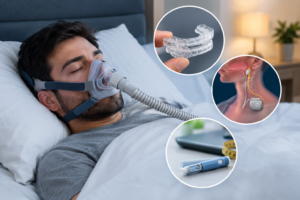
Some people have what is commonly called positional sleep apnea, where breathing problems are substantially worse in certain sleeping positions. Dallas Sleep’s oral appliance therapy information specifically identifies positional sleep apnea among the situations in which an oral appliance may be considered, although treatment suitability depends on an individual’s sleep study, anatomy, severity of sleep apnea, and other factors.
That does not mean everyone who snores on their back has positional sleep apnea.
It means your sleeping position can be an important piece of the diagnostic picture.
If a partner tells you that you snore heavily on your back but become quiet when you turn onto your side, mention that pattern during a medical evaluation. Details that seem minor to you can help a clinician understand what happens to your breathing while you sleep.
Why you may not know how bad your snoring is
Snoring is unusual because the person producing the sound is often the least reliable observer of it.
You may fall asleep normally, remain asleep for what feels like a full night, and wake up without realizing that you were snoring loudly or repeatedly struggling to breathe.
A bed partner may notice something completely different.
They may hear loud snoring followed by silence. A partner might also notice choking or gasping during the night. In some cases, you may shift positions repeatedly or suddenly take a deep breath without realizing it.
Dallas Sleep recommends paying attention when snoring is accompanied by breathing interruptions, gasping, daytime sleepiness, or other symptoms associated with sleep apnea.
If you sleep alone, a recording device or sleep-tracking information may sometimes help you recognize patterns, although these tools should not be treated as a substitute for medical testing when sleep apnea is suspected.
What can you do if your snoring is worse on your back?
Start with the simplest observation: does your snoring consistently change with position?
If you are quieter on your side, making side sleeping more comfortable may help reduce positional snoring. You can also pay attention to whether congestion, alcohol, illness, or other factors seem to make the problem worse on particular nights.
But persistent snoring deserves more than a collection of home remedies when other symptoms are present.
If you regularly wake with headaches or a dry mouth, feel unusually tired during the day, struggle to stay awake, or have been told that you stop breathing, choke, or gasp during sleep, it is worth discussing the problem with a sleep specialist.
Dallas Sleep uses evaluation and sleep testing to identify the underlying cause of snoring and determine whether sleep apnea or another sleep disorder may be involved. Its sleep-testing services include both home sleep testing and sleep-lab studies, depending on the patient’s situation.
That distinction matters because treating the noise is not always the same thing as treating the reason behind it.
The bigger clue may be what happens after you fall asleep
If your snoring gets worse when you sleep on your back, your body may simply be responding to the mechanics of that position.
Gravity changes the relationship between your tongue, throat tissues, and airway. Sleep relaxes the muscles that help keep the airway open. For some people, that combination creates enough narrowing to produce noticeable snoring.
Sleeping on your side may reduce the sound, particularly when the problem is strongly positional.
But if the snoring is loud and persistent, or comes with gasping, choking, pauses in breathing, morning headaches, or daytime fatigue, it is worth looking beyond the sleeping position. The position may be changing the severity of the problem rather than causing the problem itself.
A sleep evaluation can help determine what is actually happening during the night. Once the cause is understood, treatment can be based on the person’s breathing, sleep study results, and individual needs rather than on the snoring sound alone.
Persistent snoring is worth paying attention to, especially when it is worse on your back or accompanied by gasping, breathing pauses, or daytime fatigue. If you are concerned about your sleep or want to understand what may be causing your symptoms, explore the sleep care and diagnostic services available through Dallas Sleep.