Best Sleep Doctor in Plano, TX: How to Choose the Right Sleep Specialist for Lasting Relief
Sleep issues rarely dramatically announce themselves. They arrive quietly. A few restless nights here, a strange fatigue there, and then slowly, something begins to feel off in a way that is hard to explain.
Not insomnia exactly. Not exhaustion in the usual sense either. Something in between.
And that is usually when people start searching.
People often begin their search with phrases like best sleep doctor in Plano, sleep specialist in Plano, TX, sleep clinic near me, or sleep apnea doctor in Plano.
But the results often feel the same. A list of names. A few ratings. Some websites sound identical after a while.
What actually matters is not always obvious at first glance.
What Defines the Best Sleep Doctor in Plano?
The phrase “best sleep doctor in Plano” sounds simple, but in practice, it carries a lot more weight than rankings or reviews.
The truth is, the best sleep specialist is not defined by visibility alone. It is defined by how well complex sleep patterns are interpreted and treated over time.
Sleep medicine is less about quick answers and more about reading between the lines that most people overlook.
A strong sleep doctor typically brings together three things:
- Experience across multiple sleep disorders, not just one condition
- The ability to diagnose accurately through structured sleep testing
- A treatment approach that adapts as the patient’s sleep evolves
At Dallas Sleep, care is built around this idea of layered understanding. Sleep problems are rarely isolated. They tend to overlap, shift, and evolve in subtle ways.
Sometimes the hardest part is not identifying the problem. It is recognizing that multiple small problems are connected.
Why Sleep Disorders Are Frequently Misdiagnosed or Overlooked in Plano
Sleep issues tend to disguise themselves as everyday fatigue.
People often attribute it to stress, screen time, aging, or just the demands of a busy life.
And sometimes, yes, that is true.
But in many cases, something more structured is happening beneath the surface.
Sleep apnea is often misunderstood, as it does not always present as loud snoring or obvious breathing interruptions. Instead, it can show up as:
- Waking up tired despite a full night in bed
- Morning headaches that fade later in the day
- Difficulty focusing or memory lapses
- A sense of light, fragmented sleep that never feels complete
According to the American Academy of Sleep Medicine, untreated sleep apnea is associated with long-term cardiovascular and metabolic risks, making early diagnosis important rather than optional.
That realization often changes how patients interpret their symptoms.
What once felt like an inconvenience begins to feel like something worth understanding properly.
Sleep Specialist Plano, TX: When Is the Right Time to Seek Help?
There is rarely a perfect moment to see a sleep specialist. Most people arrive at the decision gradually, after noticing patterns that do not resolve on their own.
In Plano, TX, people usually turn to a sleep specialist when sleep no longer feels restorative and begins to feel inconsistent or unreliable.
Some common signals include:
- Sleep that feels unrefreshing even after adequate hours
- Frequent snoring or breathing irregularities noticed by others
- Difficulty staying asleep or waking too early repeatedly
- Daytime fatigue that affects focus or emotional stability
- Sleep that feels shallow, light, or fragmented most nights
These symptoms do not need to be extreme to matter. Consistency is often more important than intensity.
Sleep disorders usually develop gradually, and people often overlook them until they begin to interfere with daily functioning.
What Happens Inside a Sleep Clinic in Texas?
Many people think of a sleep clinic as a place only for “serious cases,” but in reality, it focuses on careful diagnosis and a clearer understanding of how sleep is functioning.
The process usually begins with a structured evaluation rather than immediate treatment assumptions.
At Dallas Sleep, diagnosis typically involves:
- Home sleep testing for convenience and initial screening
- In-lab sleep studies for more complex or unclear cases
- Detailed analysis of breathing patterns, sleep cycles, and interruptions
Sleep studies are often less intimidating than people expect. They simply observe natural sleep patterns as sensors record signals the body already produces, without interference or disruption.
What often surprises patients is not the process itself, but the results.
Many people only realize later that their sleep was broken far more often than they thought, in subtle, repeated interruptions that never quite wake them fully.
That is usually where clarity begins.
Sleep Apnea Doctor in Plano: Understanding Treatment Options
After a diagnosis is confirmed, treatment usually begins, but sleep medicine often moves in a more layered and less predictable way.
There is no single solution that fits every patient.
A sleep apnea doctor in Plano may recommend different approaches depending on severity, comfort, and long-term suitability.
Common treatment options include:
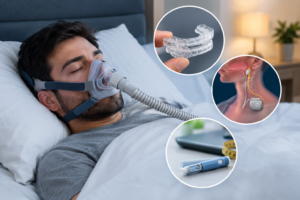
- CPAP therapy to maintain open airways during sleep
- BiPAP therapy for more complex breathing support needs
- Oral appliance therapy for patients who cannot tolerate CPAP
- Lifestyle adjustments that support sleep stability over time
At Dallas Sleep, treatment is not treated as a fixed endpoint. It is adjusted over time, based on how the patient responds.
Sleep improvement is rarely instant. It tends to evolve slowly, almost quietly, as the body adapts.
There is often a point where patients realize they are no longer just “managing” sleep but actually recovering it.
Choosing the Right Sleep Clinic: What Matters Beyond the Website
Most people compare sleep clinics based on proximity, reviews, or insurance coverage. Those factors matter, but they are not always the most important indicators of long-term success.
A more meaningful evaluation usually includes:
- Whether the clinic treats multiple sleep disorders comprehensively
- Whether both adult and pediatric cases are handled
- Whether diagnostics and follow-up care are integrated
- Whether treatment plans are personalized rather than standardized
Sleep medicine is not just about identifying a condition. It is about understanding how that condition behaves in real life, over time, in different contexts.
That is where experience tends to matter more than marketing.
A Subtle Truth About Sleep Health
Most people do not realize how much sleep affects their life until it begins to improve.
The change is not dramatic. It does not arrive all at once.
It appears in smaller shifts:
- Waking up without hesitation
- Clearer thinking during the day
- A quieter mind at night
- Energy that feels more stable than forced
And slowly, sleep stops feeling like something to solve.
It becomes something that simply works again.
When Sleep Stops Feeling Optional
Sleep problems rarely feel urgent at the beginning. They are easy to postpone, easy to explain away.
But when sleep stops feeling reliable, it is usually worth paying attention.
A structured evaluation from a sleep specialist can bring clarity where uncertainty has been sitting for too long.
Clinics like Dallas Sleep exist for exactly that moment. Not when things are extreme, but when they are unclear enough to matter.
Take the Next Step Toward Better Sleep
If sleep has been inconsistent, fragmented, or unrefreshing, understanding the cause is the first real step forward.
Explore evaluation and treatment options with Dallas Sleep here:
👉 Visit Dallas Sleep
FAQ
The best sleep doctor is typically one who evaluates multiple sleep disorders using structured sleep studies and personalized treatment plans, rather than a one-size-fits-all approach.
In Plano, Dr. Raj Kakar, MD, a board-certified sleep specialist and founder of Dallas Sleep, leads a comprehensive approach to diagnosing and treating sleep disorders such as sleep apnea, insomnia, chronic fatigue, and parasomnias.
He evaluates each patient individually and builds long-term, personalized care plans using both home and in-lab sleep studies to ensure accurate diagnosis before treatment begins.
Sleep specialists diagnose and treat conditions like sleep apnea, insomnia, snoring disorders, restless sleep, and excessive daytime fatigue.
In most cases, yes. A sleep study helps measure breathing interruptions, oxygen levels, and sleep cycles to confirm the diagnosis accurately.
Clinicians may also recommend oral appliances or positional therapy based on severity and patient needs.